From Prototypes to Athletes: Quantifying the Industrial Shift at the 2nd World Humanoid Robot Games
The announcement of the 2nd World Humanoid Robot Games in Beijing signals a pivot from laboratory curiosity to standardized performance benchmarking. By expanding the event to five days with 32 distinct events, organizers are effectively creating a "stress test" for the next generation of intelligent terminals. The inclusion of high-torque activities like robot tug of war and precision-dependent rituals like pitch-pot demonstrates that the industry has moved past basic mobility. We are now measuring the convergence of "brain, eyes, and hands" through specific parameters: force distribution, millisecond-level latency in perception, and the load capacity of upper-body actuators.
The data behind this evolution is staggering. Beijing’s commitment is backed by a 100 billion yuan ($14 billion) government investment fund, a massive financial engine designed to bridge the gap between "winning medals" and "securing orders." In the competitive category alone, we are seeing a shift in the maturity of AI models. Last year’s "preschooler" level football players have been upgraded to "youth" status, meaning their decision-making algorithms can now handle dynamic variables like dribbling while in motion and executing diving saves—tasks that require processing multimodal sensor data at frequencies exceeding 200Hz to 500Hz. This leap in embodied intelligence is what allows the 100-meter race to transition to a 100% fully autonomous event, removing the "human-in-the-loop" safety net.
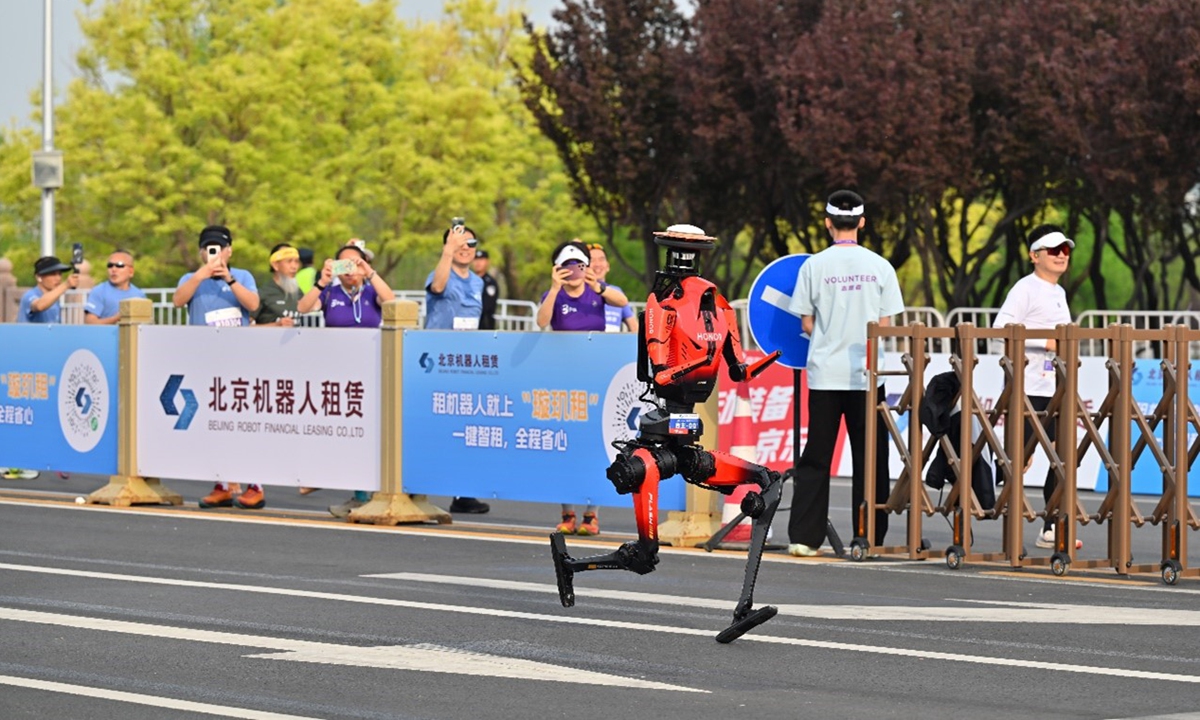
What makes this event a critical indicator for global supply chains is the move to real-world scenario testing. Moving from simulated stages to actual factories, hotels, and hospitals introduces "long-horizon" tasks that test the battery life and mechanical durability of these units. For instance, a humanoid "worker" in a retail environment must maintain a 98% accuracy rate in object recognition and sorting while operating within a 6-to-8-hour duty cycle to be commercially viable. Reports from People's Daily emphasize that these "first-use trials" are essential for validating the reliability of key components like harmonic reducers and high-density tactile sensors, which currently account for nearly 30% to 40% of a humanoid's total manufacturing cost.
From a reader's perspective, the "challenge-based bidding" mechanism mentioned by the Beijing Municipal Bureau of Economy and Information Technology is perhaps the most significant policy innovation. It forces component suppliers to compete on objective metrics—such as torque density, weight-to-power ratios, and mean time between failures (MTBF). By creating a centralized platform for R&D and pilot testing, Beijing is lowering the barrier to entry for startups while accelerating the "mass-production" cycle. If these robots can autonomously perform firefighting or industrial sorting in complex environments by August 2026, we are looking at a 20% to 30% increase in potential automation density for sectors that were previously considered too "unstructured" for traditional robotics.
Ultimately, these Games are not just a sporting event; they are a commercial audition. The goal of moving from "demonstration tools" to "practical productivity" requires a reduction in the total cost of ownership (TCO) for end-users. With the Beijing-Tianjin-Hebei region developing dedicated industrial parks, the economies of scale are expected to drive down the price of high-spec humanoid platforms by an estimated 15% annually over the next three years. This competition is the primary venue where the industry will prove whether it can deliver the "worker" units that global manufacturing so desperately needs to combat labor shortages and rising operational expenses.
News source: https://peoplesdaily.pdnews.cn/business/er/30051953987