A Men's Fragrance Line: The OEM/ODM Timeline From Brief to Shelf
A men's fragrance line at an OEM/ODM manufacturer follows a sequence that is remarkably consistent across projects: brief, development, packaging, pilot, bulk and file. The calendar time is set less by the perfume than by when decisions are made and locked. Most overshoot happens in the same three places — the scent briefing, the pack decoration and the regulatory file — and each is preventable. Plan those three gates and a men's line becomes one of the more predictable projects a buyer will run.
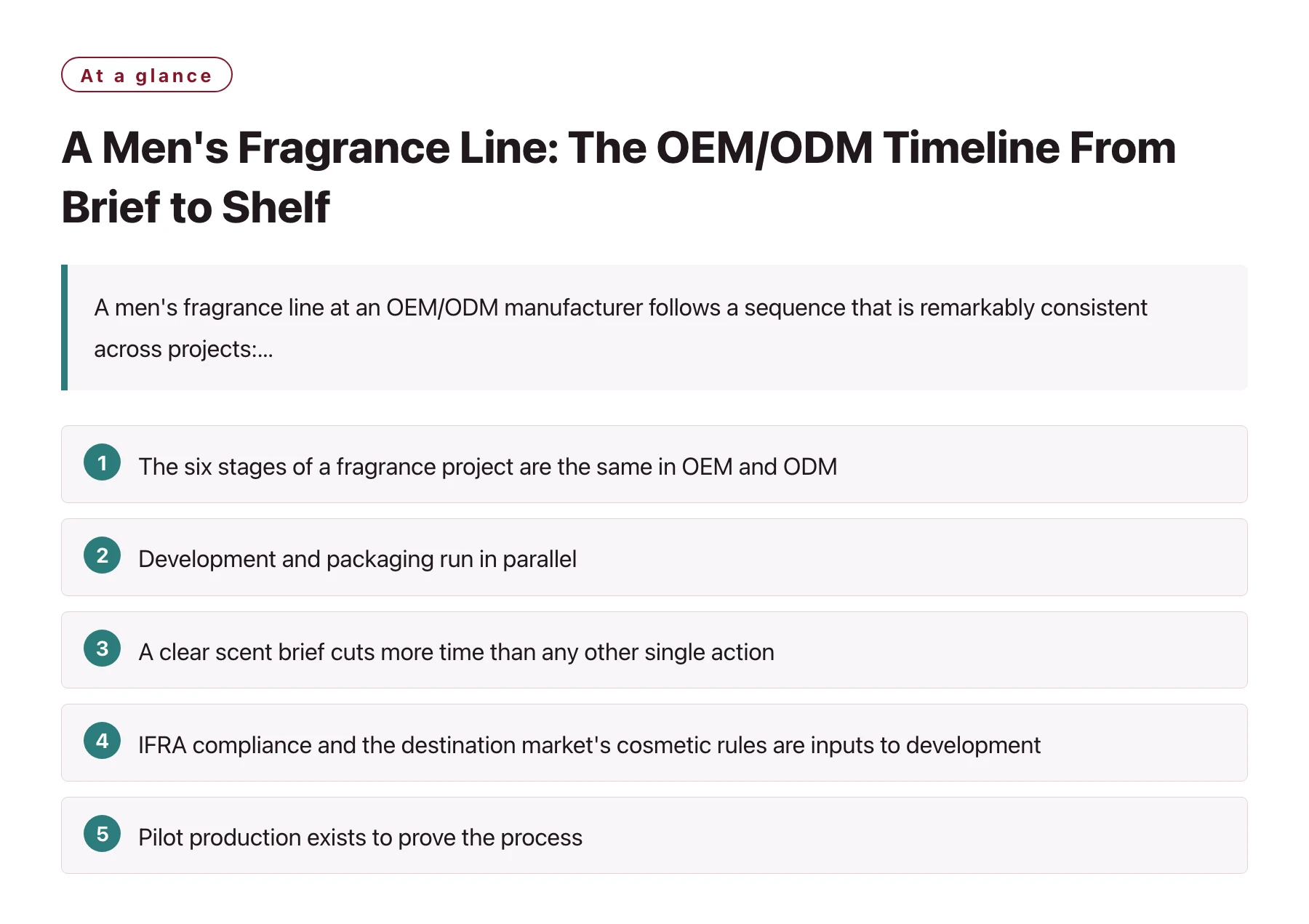
Key takeaways
- The six stages of a fragrance project are the same in OEM and ODM; the difference is who brings the formula and who carries the development risk.
- Development and packaging run in parallel, so the total timeline is set by the longest queue, normally the bottle and its decoration.
- A clear scent brief cuts more time than any other single action, because every revision after the first sample refills the whole queue behind it.
- IFRA compliance and the destination market's cosmetic rules are inputs to development, not checks performed after it [1].
- Pilot production exists to prove the process, not the scent; treat it as a rehearsal and the bulk run becomes routine.
A men's line is often a founder's second product, built on the experience of a first launch. That is both an advantage and a trap: the buyer knows enough to push for speed, but not always enough to see which corner of the timeline is hiding the risk.
This article walks through the project in the order it actually happens and flags where the weeks go. It is written for buyers comparing OEM and ODM routes for a men's fragrance, but the sequence holds for most fine fragrance projects.
The six stages, in the order they happen
Whatever the model, the work falls into six stages: brief, formula development, packaging development, pilot run, bulk production and file handover. What changes between OEM and ODM is who owns the middle two.
What OEM shifts
In an OEM arrangement the brand supplies or licenses the formula, and the factory's job is repeatability: sourcing, blending, filling and decoration to a locked specification. The timeline starts at confirmation, because the development time has already been spent.
What ODM shifts
In an ODM arrangement the factory develops from a brief, often from an existing accord library. That front-loads development into the timeline, but it usually means the first sample arrives sooner, because the starting point is proven.
The practical difference for scheduling
The scheduling difference is simple: an ODM project needs a discussion slot for development, while an OEM project needs a verification slot instead. a factory that handles fragrance R&D and production in one place can say honestly which model its calendar is built around, because the two schedules are genuinely different in the early weeks and nearly identical at the end.
Knowing the standard stages of perfume production lets a buyer ask exactly where the weeks sit in a specific quote: maceration, dilution and filtration run on the factory's calendar, not on the perfumer's the stages of perfume production.
For buyers sourcing internationally, the common route is contract perfume manufacturing in China, which compresses cost while keeping the same six stages. The timeline logic does not change with geography; only the shipping and customs tail does contract perfume manufacturing in China.
A realistic order of work
- Write the brief before the callScent direction, pack format, price band, target market and deadline. A written brief turns the first meeting into a working session.
- Lock the decision gatesFormula freeze, artwork freeze and pack sample sign-off. Name them, put dates on them, and state what happens if they move.
- Run development and packaging in parallelWhile the perfumer works, the bottle, cap and decoration are being quoted. Waiting for the scent to finish before starting the pack is the classic time leak.
- Treat the pilot as a rehearsalThe pilot run proves fill weights, decoration alignment and batch records. If it is awkward, that is exactly what it is for.
- Reserve the regulatory file timeThe destination market's documents are produced alongside production, not after it; missing them delays the ship date, not the scent.
Where men's lines go wrong on time
The first overshoot is the scent briefing. Men's fragrances are often pitched as "like X but different", which is a direction, not a brief. Every vague round adds a sampling cycle; three vague rounds can add six weeks.
The second is decoration. A men's line leans on the bottle and the box because the market is crowded, and elaborate decoration runs on scheduled machines. Ask specifically how long the decoration slot takes; it is the answer most quotes gloss over.
The third is the destination file. The EU is the reference case: cosmetics placed there must be notified and supported by a product information file, and the ingredient documentation has to line up with what was actually used [2]. Trade publications track how quickly fragrance launches move from announcement to shelf, and the pattern they document is that compliance work, not creativity, is what separates fast launches from slow ones [3].
In every men's line project there is one date that, if moved, moves everything else. Find it in the first week — it is usually the decoration slot or the regulator's calendar — and build the marketing plan around it. Projects that identify that date early finish early; projects that discover it late finish late.
Sources
- IFRA Standards Library (International Fragrance Association) —— The IFRA Standards Library lists the restrictions the fragrance industry applies to individual fragrance ingredients, based on safety assessments; it is the reference point for compliant fragrance formulation.
- European Commission: Cosmetics in the EU —— The European Commission's overview of EU cosmetics rules, including the responsible person, product information file and safety report requirements.
- Cosmetics Business —— A trade publication covering the beauty and cosmetics industry, including fragrance launches and regulatory developments.
Frequently asked questions
Is OEM or ODM faster for a men's fragrance line?
ODM is usually faster to the first sample because an existing base is adapted; OEM is faster from confirmation to bulk because development is already done. The comparison depends on where in the process you are starting.
How much of the timeline is the perfume itself?
For a fine fragrance, the scent typically accounts for a minority of the total calendar. Bottle supply, decoration, filling slots and the regulatory file each contribute as much or more.
What causes most lead time overruns for men's lines?
Vague scent briefs that add sampling rounds, decoration slots that were not quoted explicitly, and destination documentation started too late. All three are decision problems, not factory problems.
Do I need IFRA compliance documents for a men's fragrance?
IFRA standards set safe-use limits for fragrance materials, and most reputable formulators build to them as a matter of course. The buyer should ask to see the finished concentrate's IFRA statement rather than assume it.
When should I start the regulatory file for a new market?
At the same time as the pilot run, not after it. The ingredient list, IFRA statement and product information file have to describe the formula as made, so they are locked when the formula is frozen.