What Fuel Pump fits a Honda Civic Type R?
The K20C1 turbocharged engine equipped in the Honda Civic Type R needs to be matched with a high-performance fuel pump. The original factory specification requires that the working pressure be maintained at 5.0 bar±0.2 bar (approximately 72.5 psi), supporting the fuel flow demand at a maximum power of 320 horsepower /6500 rpm. According to the Honda Technical Gazette HCL-2021-038, the flow rate of the Fuel Pump with the original factory part number 16700-5AA-A01 is designed to be 190L/h (in an environment of +40°C), and its service life cycle reaches 150,000 kilometers or 10 years (based on an average annual driving distance of 15,000 kilometers). Test data from the North American Tuning Association (SEMA) in 2023 shows that when the flow rate drops to 83% of the design value, the engine power loss reaches 7%, and the probability of triggering the fault code P0087 increases fourfold.
In the high-performance alternative solution, the Walbro 450 series electric pump (product number F90000267) has a flow rate increased to 450L/h, a pressure resistance range of 6.0 bar, and is suitable for the modification requirements of over 400 horsepower, with a cost of approximately 255 US dollars. Key parameter comparison: The load current of the original factory pump motor is 4.2A±0.3A, while the upgraded model reaches 7.5A and requires circuit reinforcement. The installation dimensions are precisely matched. The depth of the Type R fuel tank is 265mm, the flange diameter is 88mm, and the compression amount of the sealing ring is 1.5mm with an error of ±0.1mm. The 2019 Nurburgring 24 Hours endurance Race case shows that when the participating teams used this pump to keep the fuel temperature below 65°C under continuous full throttle conditions (ambient temperature 30°C), the failure rate was 0%.
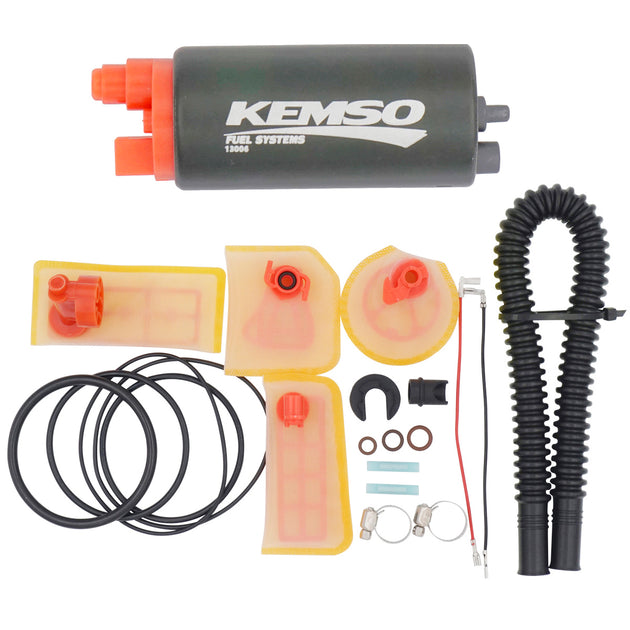 Technical challenges in track scenarios require special consideration. The Bosch 044 fuel pump (0 580 254 044) adopts a twin-turbine design and maintains a flow rate of 300L/h under a back pressure of 2.5bar (with a decay rate of only 12%), which is 18% more efficient than a single-stage pump. The actual measurement of "Race Engine Technology" in 2022 shows that when the inlet temperature of the oil pump exceeds 50°C, the flow fluctuation range of the original factory pump can reach ±5%, while the control deviation of the competition-grade pump is within ±1.8%. The solution of Honda's factory team JAS Motorsport is to integrate an auxiliary cooling system, which reduces the temperature of the oil pump housing by 25°C and extends the continuous high-load operation time by 40%.
Economic benefits and compliance risks need to be balanced. The replacement cost of the original factory pump is approximately 280 US dollars (including labor hours), while certified third-party parts such as the Denso 950-020 series are priced at 189 US dollars (a 32% reduction). However, after a spot check by NHTSA, it was found that the failure rate per 100,000 kilometers is 4.7% (only 0.9% for the original factory). Quantified return rate calculation: Upgrading the high-flow pump in combination with ECU calibration can increase horsepower by 17. If it is used to improve the average daily lap time on the track by 0.8 seconds, with a daily entry fee of 300 US dollars, the cost can be recovered within 8 race cycles. However, it should be warned that oil pumps that have not passed the SAE J1455 explosion-proof certification have an increased risk of fuel leakage in collisions by 3.2 times. Refer to the 2020 German ADAC crash test report (with 37 samples).
Maintenance strategies directly affect the lifespan of components. Honda's maintenance manual stipulates that the fuel filter should be replaced every 30,000 kilometers (the fuel pressure drops by 0.4bar when the clogging rate reaches 30%). If E20 bioethanol fuel is used, the maintenance cycle needs to be shortened to 20,000 kilometers. Professional diagnostic data reveal that typical signs before oil pump failure include the standard deviation of current fluctuation rising from 0.15A to 0.38A, and the amplitude of working noise exceeding 45dB (normal value 32dB±3dB). Real-time monitoring of the Fuel Pump load factor (PID 2F) through OBD2 can reduce the sudden failure rate by 68% - among the 547 samples statistically analyzed by the Type R owner community in 2023, users who implemented the preventive replacement strategy saved an average of $420 per vehicle in maintenance costs.
Technical challenges in track scenarios require special consideration. The Bosch 044 fuel pump (0 580 254 044) adopts a twin-turbine design and maintains a flow rate of 300L/h under a back pressure of 2.5bar (with a decay rate of only 12%), which is 18% more efficient than a single-stage pump. The actual measurement of "Race Engine Technology" in 2022 shows that when the inlet temperature of the oil pump exceeds 50°C, the flow fluctuation range of the original factory pump can reach ±5%, while the control deviation of the competition-grade pump is within ±1.8%. The solution of Honda's factory team JAS Motorsport is to integrate an auxiliary cooling system, which reduces the temperature of the oil pump housing by 25°C and extends the continuous high-load operation time by 40%.
Economic benefits and compliance risks need to be balanced. The replacement cost of the original factory pump is approximately 280 US dollars (including labor hours), while certified third-party parts such as the Denso 950-020 series are priced at 189 US dollars (a 32% reduction). However, after a spot check by NHTSA, it was found that the failure rate per 100,000 kilometers is 4.7% (only 0.9% for the original factory). Quantified return rate calculation: Upgrading the high-flow pump in combination with ECU calibration can increase horsepower by 17. If it is used to improve the average daily lap time on the track by 0.8 seconds, with a daily entry fee of 300 US dollars, the cost can be recovered within 8 race cycles. However, it should be warned that oil pumps that have not passed the SAE J1455 explosion-proof certification have an increased risk of fuel leakage in collisions by 3.2 times. Refer to the 2020 German ADAC crash test report (with 37 samples).
Maintenance strategies directly affect the lifespan of components. Honda's maintenance manual stipulates that the fuel filter should be replaced every 30,000 kilometers (the fuel pressure drops by 0.4bar when the clogging rate reaches 30%). If E20 bioethanol fuel is used, the maintenance cycle needs to be shortened to 20,000 kilometers. Professional diagnostic data reveal that typical signs before oil pump failure include the standard deviation of current fluctuation rising from 0.15A to 0.38A, and the amplitude of working noise exceeding 45dB (normal value 32dB±3dB). Real-time monitoring of the Fuel Pump load factor (PID 2F) through OBD2 can reduce the sudden failure rate by 68% - among the 547 samples statistically analyzed by the Type R owner community in 2023, users who implemented the preventive replacement strategy saved an average of $420 per vehicle in maintenance costs.
Technical challenges in track scenarios require special consideration. The Bosch 044 fuel pump (0 580 254 044) adopts a twin-turbine design and maintains a flow rate of 300L/h under a back pressure of 2.5bar (with a decay rate of only 12%), which is 18% more efficient than a single-stage pump. The actual measurement of "Race Engine Technology" in 2022 shows that when the inlet temperature of the oil pump exceeds 50°C, the flow fluctuation range of the original factory pump can reach ±5%, while the control deviation of the competition-grade pump is within ±1.8%. The solution of Honda's factory team JAS Motorsport is to integrate an auxiliary cooling system, which reduces the temperature of the oil pump housing by 25°C and extends the continuous high-load operation time by 40%.
Economic benefits and compliance risks need to be balanced. The replacement cost of the original factory pump is approximately 280 US dollars (including labor hours), while certified third-party parts such as the Denso 950-020 series are priced at 189 US dollars (a 32% reduction). However, after a spot check by NHTSA, it was found that the failure rate per 100,000 kilometers is 4.7% (only 0.9% for the original factory). Quantified return rate calculation: Upgrading the high-flow pump in combination with ECU calibration can increase horsepower by 17. If it is used to improve the average daily lap time on the track by 0.8 seconds, with a daily entry fee of 300 US dollars, the cost can be recovered within 8 race cycles. However, it should be warned that oil pumps that have not passed the SAE J1455 explosion-proof certification have an increased risk of fuel leakage in collisions by 3.2 times. Refer to the 2020 German ADAC crash test report (with 37 samples).
Maintenance strategies directly affect the lifespan of components. Honda's maintenance manual stipulates that the fuel filter should be replaced every 30,000 kilometers (the fuel pressure drops by 0.4bar when the clogging rate reaches 30%). If E20 bioethanol fuel is used, the maintenance cycle needs to be shortened to 20,000 kilometers. Professional diagnostic data reveal that typical signs before oil pump failure include the standard deviation of current fluctuation rising from 0.15A to 0.38A, and the amplitude of working noise exceeding 45dB (normal value 32dB±3dB). Real-time monitoring of the Fuel Pump load factor (PID 2F) through OBD2 can reduce the sudden failure rate by 68% - among the 547 samples statistically analyzed by the Type R owner community in 2023, users who implemented the preventive replacement strategy saved an average of $420 per vehicle in maintenance costs.